top of page

In the follow-up book to There’s No Such Thing as Dragons, the story continues, but it’ll continue in smaller pieces.

When I was a kid I was more interested in running around outside than reading books, so when I did have to read, and I had a choice about what to read, I always chose books with the shortest chapters. That way I could stop reading sooner and get back outside.


I still have that feeling now but it doesn’t impact my book choices anymore.


I recently picked up a book called Northern Spy by Flynn Berry, published in 2021. It’s a fine book targeted for an adult audience and contains blissfully short chapters.


I’m now reading No Country For Old Men by Cormac McCarthy, published in 2005. It contains chapter lengths that I expect, 15-20 pages or so.


Based on no research and an obviously small sample size, I wonder the following: are book chapters getting smaller to accommodate shrinking attention spans? No shade on Flynn Berry here, by the way. It's just that the difference between the books got me thinking.


Recognizing that my books are meant for middle graders, mostly, I’m going to make a change in my formatting that 12 year old me would have really appreciated.


I'll have unlimited small chapters, some might just be a page or two. Those will be numbered. Maybe more than a hundred. Then, some of those chapters will have titles. There are currently 22 titled chapters. Each titled chapter will mark the change in perspective between the two story lines. Here is where I reveal the first three chapter titles as an example:


CHAPTER

TITLED

STORYLINE

1

Disharmony

Alexandria

2


Alexandria

3


Alexandria

4


Alexandria

5


Alexandria

6

Marie

Plainsette

7


Plainsette

8


Plainsette

9


Plainsette

10

Humiliation

Alexandria

11


Alexandria

12


Alexandria

13


Alexandria


I hope this makes for an easier read.


FOR IMMEDIATE RELEASE


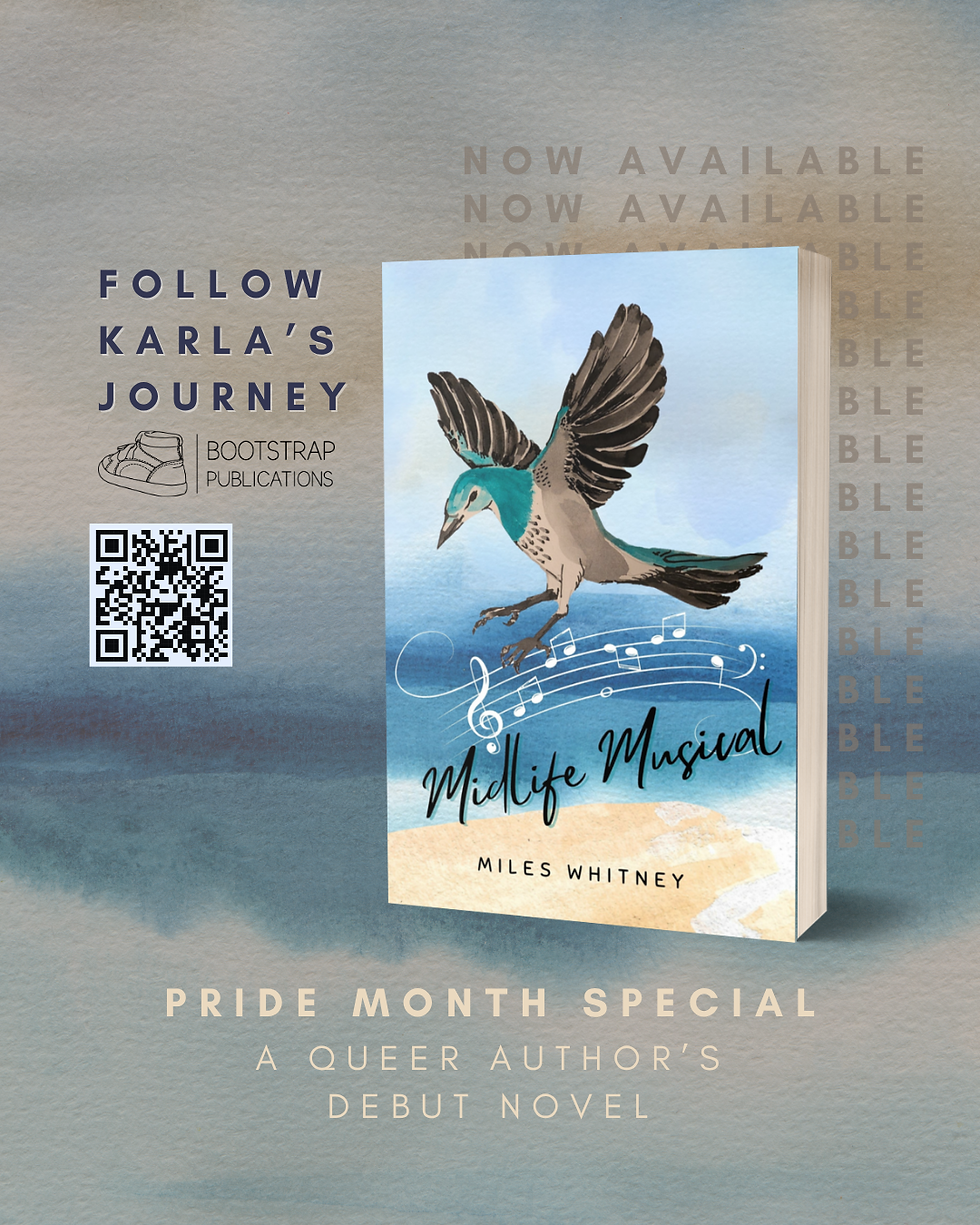
South Lake Tahoe, CA - Bootstrap Publications, in our ongoing mission to publish impactful and meaningful works, is proud to announce the release of Midlife Musical by Miles Whitney. This contemporary literary novel brings an insightful perspective as a queer debut novelist and contemporary storyteller to the forefront, offering readers a powerful exploration of forgotten dreams, personal awakening, second chances, and the profound journey of finding one's authentic voice.


Midlife Musical provides an inspiring, emotionally resonant look at the power of creative reclamation, showing that it is never too late to find the voice we thought we left behind. Drawing on Miles Whitney’s unique insights and lived experiences as a queer creator, Miles presents a triumphant narrative that offers hope and validation to anyone navigating the quiet crises of lost passions and buried family truths.


Key Highlights of Midlife Musical:

  • A poignant exploration of the psychological struggle between comfortable suburban routine and the fierce, undeniable call of creative self-expression.

  • A rich, melody-driven exploration of the raw vulnerability of songwriting, the rediscovery of childhood passion, and the hard-won courage it takes to share your art with the world.

  • A raw, honest look at how bringing long-buried secrets into the open can mend fracturing marital and parental connections.


Midlife Musical introduces readers to Karla, a suburban real estate agent living a quiet double life as a late-night songwriter, providing a compelling narrative that empowers readers to step out of their comfortable routines, face their fears, and reclaim their own forgotten passions.


Beyond his debut novel, Miles Whitney has built a prolific literary presence with an extensive catalog of published essays and creative works. Most notably, he was named the first-place winner of the prestigious 2025 New Feathers Award for his profound nonfiction piece, "Artifact of Death, Artifact of Life," published on July 21, 2025, in the New Feathers Anthology.


About Miles Whitney: Miles Whitney is a queer, trans, Jewish attorney based in Sacramento, California. As a research attorney for the trial court, Miles channels his passion for justice into both his legal work and his creative writing. After the unexpected loss of his daughter, Isabel, in 2022, Miles began writing nonfiction essays and fiction that explore themes of grief, identity, and resilience.


​Miles’ work has been featured in a variety of publications, including Freedom Fiction Journal, Homo Works, and Discretionary Love. Outside of writing and law, Miles enjoys reading Torah and training dogs, weaving together his love for storytelling, faith, and community.


Connect with Miles Whitney:

For more information on Midlife Musical or to schedule an interview with Miles Whitney, please contact: info@chibur.info


Industry(s): Book Publishing, Creative Writing, LGBTQ+ Media, Arts & Entertainment


The book trailer for William D. Sandwich’s debut novel, There’s No Such Thing as Dragons, is out now. It features an elaborate slideshow with lots of animated elements. Although William originally wanted to pursue a traditional form of animation, he utilized AI for generating still images—not for chasing the rise in the use of AI trend, but rather, creativity borne from practicality.

“Only the still images in the trailer are AI because I can’t afford a real artist. Fingers-crossed for book 2.”

When asked about the core aesthetic of the trailer, which features a Medieval Europe or 17th-century feel and a black-and-gold theme based on the book cover, William explained his process:

“The aesthetic just happened. The AI pictures were too big, taking up the whole screen, so the top/bottom bars were added—and near-black turned out to be the best choice for them.To match the book cover I made the text near-gold. That settled on the black-and-gold theme.”

William said he utilized Leonardo.ai, an AI image creator, in generating the still images, using prompts including the words “Medieval Europe” or “17th century” to build a world far from the modern period.

“I had to experiment with different models to find some that could interpret my prompt how I wanted. After I got a picture I was satisfied with, I took it into photo imaging software to apply filters for the final look that I wanted.”

William utilized AI to generate the stills, then proceeded with adding his own creative flair in making the images reflect his artistry. He manipulated the visuals using imaging software, hence the final products, after which he assembled the images in an animation editor.

Beyond the technicalities, William shared a piece on his vision for the emotion he wished to evoke:

“As far as the emotion I want to evoke, I want a family theme, a wholesome feel, combined with action.”

William also walked us through the entire ideation process and some of the creative challenges he faced when incorporating AI into the trailer.

“I consider AI as a minor piece of the equation. AI is annoying to get just right, but eventually you find a prompt that is good enough.”

The real challenge, he explained, was making the still images visually compelling. The solution? Movement. By animating the images and adding dynamic elements, he transformed static artwork into an engaging visual story.


Movement extended beyond simple slide transitions. Fireflies—a small but meaningful element from the story—added life to the visuals.

“Thankfully, it’s easy to draw yellow dots.”

William even included playful interactive details. On the slide reading ‘Who knows what you’ll find,’ he intentionally placed a frog off-center, challenging viewers to spot it. These subtle touches invite the audience to engage with the trailer on multiple levels, blending fun with narrative depth.

Music and rhythm played an essential role. William sourced the perfect track by Kistol from OpenGameArt, a video game asset website.

“I made a video game trailer years ago, the only time I did any video editing, and discovered pretty quickly that everything depends on rhythm… The music (by Kistol) almost perfectly matches the slides. I could have tweaked the timing… but the music still ended the video perfectly.”

About the color scheme, it was guided by the book cover: darkness punctuated by spots of gold, reflecting both the story’s challenges and its moments of brightness.

“This is not a good time in Alexandria’s valley, but she finds some bright spots along the way.”

The trailer was designed to hint at the plot without revealing key details, ending on a sweet note with girls around a campfire—a late but meaningful addition.


Importantly, William emphasizes that the trailer is not an AI creation. Rather, it was built in an animation editor using AI-generated still images, with all pacing, movement, and final touches carefully crafted by hand.


Ultimately, this book trailer is a testament to creativity over convention. AI provided raw materials, but human vision shaped the story, rhythm, and playful interactions. Through careful attention to mood, pacing, and subtle visual motifs, William transformed simple still images into a vibrant, engaging trailer—proof that imagination, resourcefulness, and a little digital magic can go a long way.


Beyond the trailer, the audiobook is now available.


There’s No Such Thing as Dragons Audiobook out now!

Written by William D. Sandwich

Narrated by Tim Dalgleish


bottom of page